
*ChatGPT is bullshit * Michael Townsen Hicks1 · James Humphries1 · Joe Slater1 /Abstract /Recently, there has been considerable interest in large language models: machine learning systems which produce human- like text and dialogue. Applications of these systems have been plagued by persistent inaccuracies in their output; these are often called “AI hallucinations”. We argue that these falsehoods, and the overall activity of large language models, is better understood as bullshit in the sense explored by Frankfurt (On Bullshit, Princeton, 2005): the models are in an important way indifferent to the truth of their outputs. We distinguish two ways in which the models can be said to be bullshitters, and argue that they clearly meet at least one of these definitions. We further argue that describing AI misrepresentations as bullshit is both a more useful and more accurate way of predicting and discussing the behaviour of these systems. https://link.springer.com/article/10.1007/s10676-024-09775-5 Hicks, M.T., Humphries, J. & Slater, J. ChatGPT is bullshit. /Ethics Inf Technol/ *26*, 38 (2024). https://doi.org/10.1007/s10676-024-09775-5 * Published 08 June 2024 * DOIhttps://doi.org/10.1007/s10676-024-09775-5

Molto interessante, grazie. Io di solito per "bullshit" intendo "stronzate". A mo' di verifica ho chiesto di tradurre il termine al traduttore Google. La risposta è stata "cazzate". Se lo dice lui... Il giorno mer 19 giu 2024 alle ore 10:51 J.C. DE MARTIN < juancarlos.demartin@polito.it> ha scritto:
*ChatGPT is bullshit * Michael Townsen Hicks1 · James Humphries1 · Joe Slater1
*Abstract *Recently, there has been considerable interest in large language models: machine learning systems which produce human- like text and dialogue. Applications of these systems have been plagued by persistent inaccuracies in their output; these are often called “AI hallucinations”. We argue that these falsehoods, and the overall activity of large language models, is better understood as bullshit in the sense explored by Frankfurt (On Bullshit, Princeton, 2005): the models are in an important way indifferent to the truth of their outputs. We distinguish two ways in which the models can be said to be bullshitters, and argue that they clearly meet at least one of these definitions. We further argue that describing AI misrepresentations as bullshit is both a more useful and more accurate way of predicting and discussing the behaviour of these systems.
https://link.springer.com/article/10.1007/s10676-024-09775-5
Hicks, M.T., Humphries, J. & Slater, J. ChatGPT is bullshit. *Ethics Inf Technol* *26*, 38 (2024). https://doi.org/10.1007/s10676-024-09775-5
-
Published 08 June 2024 -
Beh, il pamphlet di Harry Franfurt è stato tradotto in italiano col titolo: "Stronzate. Un saggio filosofico". jc On 19/06/24 11:28, Franco Marra wrote:
Molto interessante, grazie. Io di solito per "bullshit" intendo "stronzate". A mo' di verifica ho chiesto di tradurre il termine al traduttore Google. La risposta è stata "cazzate". Se lo dice lui...
Il giorno mer 19 giu 2024 alle ore 10:51 J.C. DE MARTIN <juancarlos.demartin@polito.it> ha scritto:
*ChatGPT is bullshit * Michael Townsen Hicks1 · James Humphries1 · Joe Slater1
/Abstract /Recently, there has been considerable interest in large language models: machine learning systems which produce human- like text and dialogue. Applications of these systems have been plagued by persistent inaccuracies in their output; these are often called “AI hallucinations”. We argue that these falsehoods, and the overall activity of large language models, is better understood as bullshit in the sense explored by Frankfurt (On Bullshit, Princeton, 2005): the models are in an important way indifferent to the truth of their outputs. We distinguish two ways in which the models can be said to be bullshitters, and argue that they clearly meet at least one of these definitions. We further argue that describing AI misrepresentations as bullshit is both a more useful and more accurate way of predicting and discussing the behaviour of these systems.
https://link.springer.com/article/10.1007/s10676-024-09775-5
Hicks, M.T., Humphries, J. & Slater, J. ChatGPT is bullshit. /Ethics Inf Technol/ *26*, 38 (2024). https://doi.org/10.1007/s10676-024-09775-5
*
Published 08 June 2024
*

Il libro di Graeber, Bullshit jobs, in italiano ha mantenuto il titolo originale ma nel testo è tradotto lavori di merda. Andrea Surbone +39 335 7226007 <http://www.surbone.it/> www.surbone.it <http://www.jussemper.org/> www.jussemper.org <http://www.propostaneokeynesiana.it/> www.propostaneokeynesiana.it D. Astrologo, A. Surbone, P. Terna Il lavoro e il valore al tempo dei robot - Intelligenza artificiale e non-occupazione Meltemi, Milano 2019 – con prefazione di Adam Smith <http://www.meltemieditore.it/catalogo/lavoro-valore-allepoca-dei-robot/> www.meltemieditore.it/catalogo/lavoro-valore-allepoca-dei-robot/ Da: nexa <nexa-bounces@server-nexa.polito.it> Per conto di J.C. DE MARTIN Inviato: mercoledì 19 giugno 2024 11:34 A: Franco Marra <marrafranco@gmail.com> Cc: Nexa <nexa@server-nexa.polito.it> Oggetto: Re: [nexa] "ChatGPT is bullshit" Beh, il pamphlet di Harry Franfurt è stato tradotto in italiano col titolo: "Stronzate. Un saggio filosofico". jc On 19/06/24 11:28, Franco Marra wrote: Molto interessante, grazie. Io di solito per "bullshit" intendo "stronzate". A mo' di verifica ho chiesto di tradurre il termine al traduttore Google. La risposta è stata "cazzate". Se lo dice lui... Il giorno mer 19 giu 2024 alle ore 10:51 J.C. DE MARTIN <juancarlos.demartin@polito.it <mailto:juancarlos.demartin@polito.it> > ha scritto: ChatGPT is bullshit Michael Townsen Hicks1 · James Humphries1 · Joe Slater1 Abstract Recently, there has been considerable interest in large language models: machine learning systems which produce human- like text and dialogue. Applications of these systems have been plagued by persistent inaccuracies in their output; these are often called “AI hallucinations”. We argue that these falsehoods, and the overall activity of large language models, is better understood as bullshit in the sense explored by Frankfurt (On Bullshit, Princeton, 2005): the models are in an important way indifferent to the truth of their outputs. We distinguish two ways in which the models can be said to be bullshitters, and argue that they clearly meet at least one of these definitions. We further argue that describing AI misrepresentations as bullshit is both a more useful and more accurate way of predicting and discussing the behaviour of these systems. https://link.springer.com/article/10.1007/s10676-024-09775-5 Hicks, M.T., Humphries, J. & Slater, J. ChatGPT is bullshit. Ethics Inf Technol 26, 38 (2024). https://doi.org/10.1007/s10676-024-09775-5 * Published 08 June 2024 * DOI https://doi.org/10.1007/s10676-024-09775-5

On mer, 2024-06-19 at 11:34 +0200, J.C. DE MARTIN wrote:
Beh, il pamphlet di Harry Franfurt è stato tradotto in italiano col titolo: "Stronzate. Un saggio filosofico".
Un link?
On 19/06/24 11:28, Franco Marra wrote:
Molto interessante, grazie. Io di solito per "bullshit" intendo "stronzate". A mo' di verifica ho chiesto di tradurre il termine al traduttore Google. La risposta è stata "cazzate". Se lo dice lui...
Il giorno mer 19 giu 2024 alle ore 10:51 J.C. DE MARTIN <juancarlos.demartin@polito.it> ha scritto:
ChatGPT is bullshit
Michael Townsen Hicks1 · James Humphries1 · Joe Slater1
Abstract Recently, there has been considerable interest in large language models: machine learning systems which produce human- like text and dialogue. Applications of these systems have been plagued by persistent inaccuracies in their output; these are often called “AI hallucinations”. We argue that these falsehoods, and the overall activity of large language models, is better understood as bullshit in the sense explored by Frankfurt (On Bullshit, Princeton, 2005): the models are in an important way indifferent to the truth of their outputs. We distinguish two ways in which the models can be said to be bullshitters, and argue that they clearly meet at least one of these definitions. We further argue that describing AI misrepresentations as bullshit is both a more useful and more accurate way of predicting and discussing the behaviour of these systems.
https://link.springer.com/article/10.1007/s10676-024-09775-5
Hicks, M.T., Humphries, J. & Slater, J. ChatGPT is bullshit. Ethics Inf Technol 26, 38 (2024). https://doi.org/10.1007/s10676-024-09775-5 * Published 08 June 2024 * DOI https://doi.org/10.1007/s10676-024-09775-5
Una ricerca su un motore di ricerca, sul sito di una biblioteca o di una libreria online? On 19/06/24 12:02, Marco A. Calamari wrote:
On mer, 2024-06-19 at 11:34 +0200, J.C. DE MARTIN wrote:
Beh, il pamphlet di Harry Franfurt è stato tradotto in italiano col titolo: "Stronzate. Un saggio filosofico".
Un link?
On 19/06/24 11:28, Franco Marra wrote:
Molto interessante, grazie. Io di solito per "bullshit" intendo "stronzate". A mo' di verifica ho chiesto di tradurre il termine al traduttore Google. La risposta è stata "cazzate". Se lo dice lui...
Il giorno mer 19 giu 2024 alle ore 10:51 J.C. DE MARTIN <juancarlos.demartin@polito.it> ha scritto:
*ChatGPT is bullshit * Michael Townsen Hicks1 · James Humphries1 · Joe Slater1
/Abstract /Recently, there has been considerable interest in large language models: machine learning systems which produce human- like text and dialogue. Applications of these systems have been plagued by persistent inaccuracies in their output; these are often called “AI hallucinations”. We argue that these falsehoods, and the overall activity of large language models, is better understood as bullshit in the sense explored by Frankfurt (On Bullshit, Princeton, 2005): the models are in an important way indifferent to the truth of their outputs. We distinguish two ways in which the models can be said to be bullshitters, and argue that they clearly meet at least one of these definitions. We further argue that describing AI misrepresentations as bullshit is both a more useful and more accurate way of predicting and discussing the behaviour of these systems.
https://link.springer.com/article/10.1007/s10676-024-09775-5
Hicks, M.T., Humphries, J. & Slater, J. ChatGPT is bullshit. /Ethics Inf Technol/ *26*, 38 (2024). https://doi.org/10.1007/s10676-024-09775-5
*
Published 08 June 2024
*

Buongiorno, Franco Marra <marrafranco@gmail.com> writes:
Molto interessante, grazie. Io di solito per "bullshit" intendo "stronzate". A mo' di verifica ho chiesto di tradurre il termine al traduttore Google. La risposta è stata "cazzate". Se lo dice lui...
mai fidarsi delle /stronzate/ che spara il traduttore di Google, non sa cosa dice :-) anche se spesso usata come sinonimo, la parola cazzata [1] non rende per nulla l'idea di quanto lo faccia bullshit, ovvero stronzata [2], la cui etimologia sia inglese che italiana [3] è chiarissima e richiama _anche_ l'odore che emana: https://www.etymonline.com/word/bullshit --8<---------------cut here---------------start------------->8--- also bull shit, "eloquent and insincere rhetoric," 1914, American English slang; see bull (n.1) + shit (n.), probably because it smells. But bull in the sense of "trivial or false statements" (1914), which usually is associated with this, might be a continuation of Middle English bull "false talk, fraud" (see bull (n.3)). --8<---------------cut here---------------end--------------->8--- Quindi "bullshit": eloquent and insincere rethoric... that smells. Per una trattazione più ampia si veda: https://en.wiktionary.org/wiki/bullshit#Etymology [...] saluti, 380° [1] https://www.treccani.it/vocabolario/cazzata/ s. f. [der. di cazzo], volg. – 1. Sciocchezza, stupidaggine: dire, fare una cazzata. 2. Sgridata, rimprovero violento: mi ha fatto una c. che non finiva più. In questo sign., è da ritenersi un adattam. del napol. cazziata (der. di cazzià’ «sgridare, rimproverare»). [2] https://it.wiktionary.org/wiki/stronzata affermazione o azione insensata, falsa o scorretta [3] ...e Portoghese (falar merda), Spagnolo (hablar mierda), Francese... -- 380° (Giovanni Biscuolo public alter ego) «Noi, incompetenti come siamo, non abbiamo alcun titolo per suggerire alcunché» Disinformation flourishes because many people care deeply about injustice but very few check the facts. Ask me about <https://stallmansupport.org>.
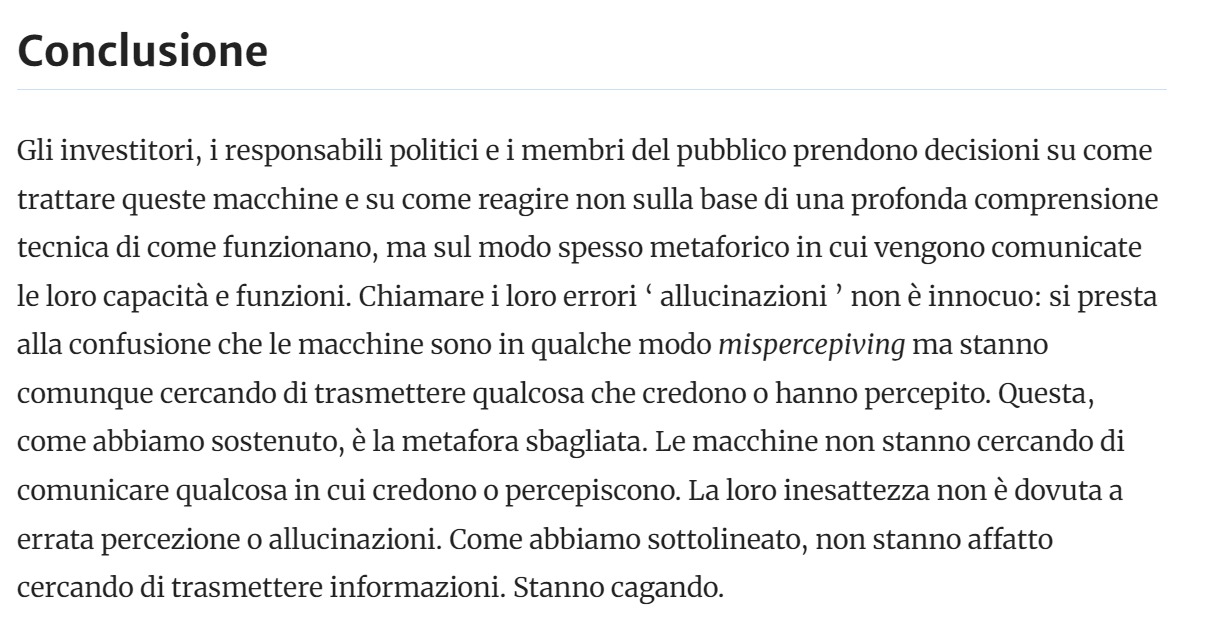
Impagabile la traduzione della conclusione, che includo come immagine perché l'articolo non mi fa copiare. Gli sto facendo fare il giro del mondo. And it smells too :))) [image: Immagine WhatsApp 2024-06-19 ore 15.37.24_665dcb05.jpg] Il giorno mer 19 giu 2024 alle ore 15:24 380° via nexa < nexa@server-nexa.polito.it> ha scritto:
Buongiorno,
Franco Marra <marrafranco@gmail.com> writes:
Molto interessante, grazie. Io di solito per "bullshit" intendo "stronzate". A mo' di verifica ho chiesto di tradurre il termine al traduttore Google. La risposta è stata "cazzate". Se lo dice lui...
mai fidarsi delle /stronzate/ che spara il traduttore di Google, non sa cosa dice :-)
anche se spesso usata come sinonimo, la parola cazzata [1] non rende per nulla l'idea di quanto lo faccia bullshit, ovvero stronzata [2], la cui etimologia sia inglese che italiana [3] è chiarissima e richiama _anche_ l'odore che emana:
https://www.etymonline.com/word/bullshit
--8<---------------cut here---------------start------------->8---
also bull shit, "eloquent and insincere rhetoric," 1914, American English slang; see bull (n.1) + shit (n.), probably because it smells. But bull in the sense of "trivial or false statements" (1914), which usually is associated with this, might be a continuation of Middle English bull "false talk, fraud" (see bull (n.3)).
--8<---------------cut here---------------end--------------->8---
Quindi "bullshit": eloquent and insincere rethoric... that smells.
Per una trattazione più ampia si veda: https://en.wiktionary.org/wiki/bullshit#Etymology
[...]
saluti, 380°
[1] https://www.treccani.it/vocabolario/cazzata/ s. f. [der. di cazzo], volg. – 1. Sciocchezza, stupidaggine: dire, fare una cazzata. 2. Sgridata, rimprovero violento: mi ha fatto una c. che non finiva più. In questo sign., è da ritenersi un adattam. del napol. cazziata (der. di cazzià’ «sgridare, rimproverare»).
[2] https://it.wiktionary.org/wiki/stronzata affermazione o azione insensata, falsa o scorretta
[3] ...e Portoghese (falar merda), Spagnolo (hablar mierda), Francese...
-- 380° (Giovanni Biscuolo public alter ego)
«Noi, incompetenti come siamo, non abbiamo alcun titolo per suggerire alcunché»
Disinformation flourishes because many people care deeply about injustice but very few check the facts. Ask me about <https://stallmansupport.org>.
Franco Marra <marrafranco@gmail.com> writes:
Impagabile la traduzione della conclusione, che includo come immagine perché l'articolo non mi fa copiare.
per curiosità con cosa hai tradotto?
Gli sto facendo fare il giro del mondo. And it smells too :)))
divertentissimo! davvero il bullshitting delle macchine è ricorsivo! :-D per paragone, questo è lo stesso brano tradotto via https://lingva.thedaviddelta.com/: --8<---------------cut here---------------start------------->8--- Conclusione Gli investitori, i politici e i membri del pubblico in generale prendono decisioni su come trattarli macchine e come reagire ad esse senza una profonda comprensione tecnica di come funzionano, ma sul modo, spesso metaforico, in cui vengono comunicate le loro capacità e funzioni. Chiamando i loro errori "allucinazioni" non sono innocue: si prestano alla confusione in cui si trovano le macchine in qualche modo fraintendono, ma cercano comunque di trasmettere qualcosa in cui credono o hanno percepito. Questa, come abbiamo sostenuto, è la metafora sbagliata. Le macchine non stanno cercando di comunicare qualcosa in cui credono o percepiscono. La loro inesattezza non è dovuta a percezioni errate o allucinazioni. COME abbiamo sottolineato, non cercano affatto di trasmettere informazioni. Stanno scherzando. --8<---------------cut here---------------end--------------->8--- puzza meno ma puzza lo stesso :-) questo con il mitico https://www.deepl.com/ --8<---------------cut here---------------start------------->8--- Conclusione Gli investitori, i politici e il pubblico in generale prendono decisioni su come trattare queste macchine e su come reagire ad esse basandosi non su una profonda comprensione tecnica del loro funzionamento, ma sul modo spesso metaforico in cui vengono comunicate le loro capacità e il loro funzionamento. Chiamare i loro errori "allucinazioni" non è innocuo: si presta alla confusione che le macchine stiano in qualche modo percependo male, ma stiano comunque cercando di trasmettere qualcosa che credono o hanno percepito. Questa, come abbiamo detto, è una metafora sbagliata. Le macchine non stanno cercando di comunicare qualcosa che credono o percepiscono. La loro imprecisione non è dovuta a una percezione errata o a un'allucinazione. Come abbiamo sottolineato, non stanno cercando di trasmettere informazioni. informazioni. Stanno dicendo cazzate. Tradotto con DeepL.com (versione gratuita) --8<---------------cut here---------------end--------------->8--- complimentoni deepl.com! [...] saluti, 380° -- 380° (Giovanni Biscuolo public alter ego) «Noi, incompetenti come siamo, non abbiamo alcun titolo per suggerire alcunché» Disinformation flourishes because many people care deeply about injustice but very few check the facts. Ask me about <https://stallmansupport.org>.
Estensione Google Transalator di Brave Il giorno mer 19 giu 2024 alle ore 16:51 380° <g380@biscuolo.net> ha scritto:
Franco Marra <marrafranco@gmail.com> writes:
Impagabile la traduzione della conclusione, che includo come immagine perché l'articolo non mi fa copiare.
per curiosità con cosa hai tradotto?
Gli sto facendo fare il giro del mondo. And it smells too :)))
divertentissimo! davvero il bullshitting delle macchine è ricorsivo! :-D
per paragone, questo è lo stesso brano tradotto via https://lingva.thedaviddelta.com/:
--8<---------------cut here---------------start------------->8---
Conclusione
Gli investitori, i politici e i membri del pubblico in generale prendono decisioni su come trattarli macchine e come reagire ad esse senza una profonda comprensione tecnica di come funzionano, ma sul modo, spesso metaforico, in cui vengono comunicate le loro capacità e funzioni. Chiamando i loro errori "allucinazioni" non sono innocue: si prestano alla confusione in cui si trovano le macchine in qualche modo fraintendono, ma cercano comunque di trasmettere qualcosa in cui credono o hanno percepito. Questa, come abbiamo sostenuto, è la metafora sbagliata. Le macchine non stanno cercando di comunicare qualcosa in cui credono o percepiscono. La loro inesattezza non è dovuta a percezioni errate o allucinazioni. COME abbiamo sottolineato, non cercano affatto di trasmettere informazioni. Stanno scherzando.
--8<---------------cut here---------------end--------------->8---
puzza meno ma puzza lo stesso :-)
questo con il mitico https://www.deepl.com/
--8<---------------cut here---------------start------------->8---
Conclusione
Gli investitori, i politici e il pubblico in generale prendono decisioni su come trattare queste macchine e su come reagire ad esse basandosi non su una profonda comprensione tecnica del loro funzionamento, ma sul modo spesso metaforico in cui vengono comunicate le loro capacità e il loro funzionamento. Chiamare i loro errori "allucinazioni" non è innocuo: si presta alla confusione che le macchine stiano in qualche modo percependo male, ma stiano comunque cercando di trasmettere qualcosa che credono o hanno percepito. Questa, come abbiamo detto, è una metafora sbagliata. Le macchine non stanno cercando di comunicare qualcosa che credono o percepiscono. La loro imprecisione non è dovuta a una percezione errata o a un'allucinazione. Come abbiamo sottolineato, non stanno cercando di trasmettere informazioni. informazioni. Stanno dicendo cazzate.
Tradotto con DeepL.com (versione gratuita) --8<---------------cut here---------------end--------------->8---
complimentoni deepl.com!
[...]
saluti, 380°
-- 380° (Giovanni Biscuolo public alter ego)
«Noi, incompetenti come siamo, non abbiamo alcun titolo per suggerire alcunché»
Disinformation flourishes because many people care deeply about injustice but very few check the facts. Ask me about <https://stallmansupport.org>.
380° <g380@biscuolo.net> writes: [...]
anche se spesso usata come sinonimo, la parola cazzata [1] non rende per nulla l'idea di quanto lo faccia bullshit, ovvero stronzata [2], la cui etimologia sia inglese che italiana [3] è chiarissima e richiama _anche_ l'odore che emana:
in merito all'etimologia (estremamente incerta) del termine bullshit trovo interessante questo articolo di Mark Liberman del 2005: «BULLSHIT: INVENTED BY T.S. ELIOT IN 1910?» http://itre.cis.upenn.edu/myl/languagelog/archives/002404.html ...a dire il vero trovo intrigante l'intera ricerca su "Language Log" [1]: https://duckduckgo.com/?q=bullshit+site%3Ahttp%3A%2F%2Fitre.cis.upenn.edu&ia... In particolare sono colpito dalla /presunta/ ignoranza grammaticale che viete attribuita ad alcuni intellettuali e accademici: 1. http://itre.cis.upenn.edu/~myl/languagelog/archives/001968.html 2. http://itre.cis.upenn.edu/~myl/languagelog/archives/001969.html «the insight about the word bullshit that Noah starts his column with -- is itself bullshit.» bullshititng... è ricorsivo :-) OK, la smetto! :-O [...] saluti, 380° [1] http://itre.cis.upenn.edu/~myl/languagelog/ -- 380° (Giovanni Biscuolo public alter ego) «Noi, incompetenti come siamo, non abbiamo alcun titolo per suggerire alcunché» Disinformation flourishes because many people care deeply about injustice but very few check the facts. Ask me about <https://stallmansupport.org>.

Molti altri - nessuno dei quali mi pare sia citato nell'articolo - hanno scritto di chatGPT come di un "bullshit generator", in senso tecnico, con riferimento a Frankfurt. Ad esempio, Dan McQuillan, https://www.danmcquillan.org/chatgpt.html Anche Richard Stallman usa spesso l'espressione: https://stallman.org/archives/2024-jan-apr.html Per quanto ne so (ma non ho indagato), il primo è stato Ezra Klein, nel 2023, intervistando Gary Marcus: ChatGPT and systems like it, what they’re going to do right now is they’re going to drive the cost of producing text and images and code and, soon enough, video and audio to basically zero. It’s all going to look and sound and read very, very convincing. That is what these systems are learning how to do. They are learning how to be convincing. They are learning how to sound and seem human. But they have no actual idea what they are saying or doing. It is bullshit. And I don’t mean bullshit as slang. I mean it in the classic philosophical definition by Harry Frankfurt. It is content that has no real relationship to the truth. [...] EZRA KLEIN: Let’s sit on that word truthful for a minute because it gets to, I think, my motivation in the conversation. I’ve been interested — I’m not an A.I. professional the way you are, but I’ve been interested for a long time. I’ve had Sam on the show, had Brian Christian on the show. And I was surprised by my mix of sort of wonder and revulsion when I started using ChatGPT because it is a very, very cool program. And in many ways, I find that its answers are much better than Google for a lot of what I would ask it. But I know enough about how it works to know that, as you were saying, truthfulness is not one of the dimensions of it. It’s synthesizing. It’s sort of copying. It’s pastiching. And I was trying to understand why I was so unnerved by it. And it got me thinking, have you ever read this great philosophy paper by Harry Frankfurt called “On Bullshit”? GARY MARCUS: I know the paper. EZRA KLEIN: So this is a — welcome to the podcast, everybody — this is a philosophy paper about what is bullshit. And he writes, quote, “The essence of bullshit is not that it is false but that it is phony. In order to appreciate this distinction, one must recognize that a fake or a phony need not be in any respect, apart from authenticity itself, inferior to the real thing. What is not genuine may not also be defective in some other way. It may be, after all, an exact copy. What is wrong with a counterfeit is not what it is like, but how it was made.” And his point is that what’s different between bullshit and a lie is that a lie knows what the truth is and has had to move in the other direction. He has this great line where he says that people telling the truth and people telling lies are playing the same game but on different teams. But bullshit just has no relationship, really, to the truth. And what unnerved me a bit about ChatGPT was the sense that we are going to drive the cost of bullshit to zero when we have not driven the cost of truthful or accurate or knowledge advancing information lower at all. And I’m curious how you see that concern. GARY MARCUS: It’s exactly right. These systems have no conception of truth. Sometimes they land on it and sometimes they don’t, but they’re all fundamentally bullshitting in the sense that they’re just saying stuff that other people have said and trying to maximize the probability of that. It’s just auto complete, and auto complete just gives you bullshit. And it is a very serious problem. I just wrote an essay called something like “The Jurassic Park Moment for A.I.” And that Jurassic Park moment is exactly that. It’s when the price of bullshit reaches zero and people who want to spread misinformation, either politically or maybe just to make a buck, start doing that so prolifically that we can’t tell the difference anymore in what we see between truth and bullshit. https://www.nytimes.com/2023/01/06/podcasts/transcript-ezra-klein-interviews... ________________________________________ Da: nexa <nexa-bounces@server-nexa.polito.it> per conto di J.C. DE MARTIN <juancarlos.demartin@polito.it> Inviato: mercoledì 19 giugno 2024 10:51 A: Nexa Oggetto: [nexa] "ChatGPT is bullshit" ChatGPT is bullshit Michael Townsen Hicks1 · James Humphries1 · Joe Slater1 Abstract Recently, there has been considerable interest in large language models: machine learning systems which produce human- like text and dialogue. Applications of these systems have been plagued by persistent inaccuracies in their output; these are often called “AI hallucinations”. We argue that these falsehoods, and the overall activity of large language models, is better understood as bullshit in the sense explored by Frankfurt (On Bullshit, Princeton, 2005): the models are in an important way indifferent to the truth of their outputs. We distinguish two ways in which the models can be said to be bullshitters, and argue that they clearly meet at least one of these definitions. We further argue that describing AI misrepresentations as bullshit is both a more useful and more accurate way of predicting and discussing the behaviour of these systems. https://link.springer.com/article/10.1007/s10676-024-09775-5 Hicks, M.T., Humphries, J. & Slater, J. ChatGPT is bullshit. Ethics Inf Technol 26, 38 (2024). https://doi.org/10.1007/s10676-024-09775-5 * Published 08 June 2024 * DOI https://doi.org/10.1007/s10676-024-09775-5

Grazie Daniela per questo riferimento. La citazione ricordata da Ezra Klein nell'intervista a Gary Marcus, sul fatto che una cosa può essere falsa ma, a parte il resto, non inferiore alla cosa reale, mi ha fatto venire in mente l'articolo di Daniel Dennet sul fatto che generare finzione attraverso l'IA è un atto immorale come produrre denaro falso. https://www.theatlantic.com/technology/archive/2023/05/problem-counterfeit-p... Ciao, Enrico ------ Messaggio originale ------ Da "Daniela Tafani" <daniela.tafani@unipi.it> A "J.C. DE MARTIN" <juancarlos.demartin@polito.it>; "Nexa" <nexa@server-nexa.polito.it> Data 19/06/2024 13:15:55 Oggetto Re: [nexa] "ChatGPT is bullshit"
Molti altri - nessuno dei quali mi pare sia citato nell'articolo - hanno scritto di chatGPT come di un "bullshit generator", in senso tecnico, con riferimento a Frankfurt.
Ad esempio, Dan McQuillan, https://www.danmcquillan.org/chatgpt.html
Anche Richard Stallman usa spesso l'espressione: https://stallman.org/archives/2024-jan-apr.html
Per quanto ne so (ma non ho indagato), il primo è stato Ezra Klein, nel 2023, intervistando Gary Marcus:
ChatGPT and systems like it, what they’re going to do right now is they’re going to drive the cost of producing text and images and code and, soon enough, video and audio to basically zero. It’s all going to look and sound and read very, very convincing. That is what these systems are learning how to do. They are learning how to be convincing. They are learning how to sound and seem human.
But they have no actual idea what they are saying or doing. It is bullshit. And I don’t mean bullshit as slang. I mean it in the classic philosophical definition by Harry Frankfurt. It is content that has no real relationship to the truth.
[...]
EZRA KLEIN: Let’s sit on that word truthful for a minute because it gets to, I think, my motivation in the conversation. I’ve been interested — I’m not an A.I. professional the way you are, but I’ve been interested for a long time. I’ve had Sam on the show, had Brian Christian on the show. And I was surprised by my mix of sort of wonder and revulsion when I started using ChatGPT because it is a very, very cool program. And in many ways, I find that its answers are much better than Google for a lot of what I would ask it.
But I know enough about how it works to know that, as you were saying, truthfulness is not one of the dimensions of it. It’s synthesizing. It’s sort of copying. It’s pastiching. And I was trying to understand why I was so unnerved by it. And it got me thinking, have you ever read this great philosophy paper by Harry Frankfurt called “On Bullshit”?
GARY MARCUS: I know the paper.
EZRA KLEIN: So this is a — welcome to the podcast, everybody — this is a philosophy paper about what is bullshit. And he writes, quote, “The essence of bullshit is not that it is false but that it is phony. In order to appreciate this distinction, one must recognize that a fake or a phony need not be in any respect, apart from authenticity itself, inferior to the real thing. What is not genuine may not also be defective in some other way. It may be, after all, an exact copy. What is wrong with a counterfeit is not what it is like, but how it was made.”
And his point is that what’s different between bullshit and a lie is that a lie knows what the truth is and has had to move in the other direction. He has this great line where he says that people telling the truth and people telling lies are playing the same game but on different teams. But bullshit just has no relationship, really, to the truth.
And what unnerved me a bit about ChatGPT was the sense that we are going to drive the cost of bullshit to zero when we have not driven the cost of truthful or accurate or knowledge advancing information lower at all. And I’m curious how you see that concern.
GARY MARCUS: It’s exactly right. These systems have no conception of truth. Sometimes they land on it and sometimes they don’t, but they’re all fundamentally bullshitting in the sense that they’re just saying stuff that other people have said and trying to maximize the probability of that. It’s just auto complete, and auto complete just gives you bullshit.
And it is a very serious problem. I just wrote an essay called something like “The Jurassic Park Moment for A.I.” And that Jurassic Park moment is exactly that. It’s when the price of bullshit reaches zero and people who want to spread misinformation, either politically or maybe just to make a buck, start doing that so prolifically that we can’t tell the difference anymore in what we see between truth and bullshit.
https://www.nytimes.com/2023/01/06/podcasts/transcript-ezra-klein-interviews... ________________________________________ Da: nexa <nexa-bounces@server-nexa.polito.it> per conto di J.C. DE MARTIN <juancarlos.demartin@polito.it> Inviato: mercoledì 19 giugno 2024 10:51 A: Nexa Oggetto: [nexa] "ChatGPT is bullshit"
ChatGPT is bullshit
Michael Townsen Hicks1 · James Humphries1 · Joe Slater1
Abstract Recently, there has been considerable interest in large language models: machine learning systems which produce human- like text and dialogue. Applications of these systems have been plagued by persistent inaccuracies in their output; these are often called “AI hallucinations”. We argue that these falsehoods, and the overall activity of large language models, is better understood as bullshit in the sense explored by Frankfurt (On Bullshit, Princeton, 2005): the models are in an important way indifferent to the truth of their outputs. We distinguish two ways in which the models can be said to be bullshitters, and argue that they clearly meet at least one of these definitions. We further argue that describing AI misrepresentations as bullshit is both a more useful and more accurate way of predicting and discussing the behaviour of these systems.
https://link.springer.com/article/10.1007/s10676-024-09775-5
Hicks, M.T., Humphries, J. & Slater, J. ChatGPT is bullshit. Ethics Inf Technol 26, 38 (2024). https://doi.org/10.1007/s10676-024-09775-5
* Published 08 June 2024
-- EN https://www.hoepli.it/libro/la-rivoluzione-informatica/9788896069516.html ====================================================== Prof. Enrico Nardelli Past President di "Informatics Europe" Direttore del Laboratorio Nazionale "Informatica e Scuola" del CINI Dipartimento di Matematica - Universit� di Roma "Tor Vergata" Via della Ricerca Scientifica snc - 00133 Roma home page: https://www.mat.uniroma2.it/~nardelli blog: https://link-and-think.blogspot.it/ tel: +39 06 7259.4204 fax: +39 06 7259.4699 mobile: +39 335 590.2331 e-mail: nardelli@mat.uniroma2.it online meeting: https://blue.meet.garr.it/b/enr-y7f-t0q-ont ====================================================== --

Il 19/06/2024 18:38, Enrico Nardelli ha scritto:
Grazie Daniela per questo riferimento. La citazione ricordata da Ezra Klein nell'intervista a Gary Marcus, sul fatto che una cosa può essere falsa ma, a parte il resto, non inferiore alla cosa reale, mi ha fatto venire in mente l'articolo di Daniel Dennet sul fatto che generare finzione attraverso l'IA è un atto immorale come produrre denaro falso. https://www.theatlantic.com/technology/archive/2023/05/problem-counterfeit-p... Ciao, Enrico
Già. "and should be held liable", scriveva Dennet. Ciao, Daniela
Buongiorno, OK, entriamo nella stalla del toro :-) Daniela Tafani <daniela.tafani@unipi.it> writes:
Il 19/06/2024 18:38, Enrico Nardelli ha scritto:
[....]
Daniel Dennet sul fatto che generare finzione attraverso l'IA
per la precisione: generare identità contraffatte (si veda sotto), non "finzione" in generale
è un atto immorale come produrre denaro falso.
innanzitutto, sapendo come e perché viene prodotto (e usato) il denaro /vero/ - mi sto riferendo /esattamente/ al combinato disposto del "military–coinage–slave complex" postulato da (l'antropologo) David Graeber [1] e la quantità impressionante di debito _creato_ dalla FED negli ultimi anni - devo confessare che ho sviluppato un discreto rispetto per i falsari di denaro, rispetto che cresce in modo inversamente proporzionale a quello che ho per i falsari della verità poi: è _immorale_ solo "generare finzione" (ovviamente senza dichiararlo) /attraverso l'AI/? quante "cose" che ora crediamo _vere_ (o _false_ [2]) sono finzioni ben congeniate da menti umane che un grande uomo definì "raffinatissime"? l'ho già detto: io sono _felice_ che l'uso dell'IA stia /facilitando/ la produzione di "denaro falso", così tocca imparare, faticosamente, a riconoscerlo :-D tipo riconoscere le debolezze del Turing Test quando si tratta di _discriminare_ se dall'altra parte c'è una persona o un _software_: https://en.wikipedia.org/wiki/Turing_test#Weaknesses --8<---------------cut here---------------start------------->8--- Numerous experts in the field, including cognitive scientist Gary Marcus, insist that the Turing test only shows how easy it is to fool humans and is not an indication of machine intelligence. [...] To successfully appear human, there is no need for the machine to have any intelligence whatsoever and only a superficial resemblance to human behaviour is required. [...] Since 2004, the Loebner Prize organisers have deployed philosophers, computer scientists, and journalists among the interrogators. Nonetheless, some of these experts have been deceived by the machines. [...] Since human behaviour and intelligent behaviour are not exactly the same thing, the test can fail [...] The Turing test is concerned strictly with how the subject acts – the external behaviour of the machine. In this regard, it takes a behaviourist or functionalist approach to the study of the mind. --8<---------------cut here---------------end--------------->8--- e mi fermo qui: "behaviourist or functionalist approach" bastano per evidenziare la puzza. eh sì, _queste_ cose dovrebbero insegnarle a partire dalle scuole elementari, altro che "nativi digitali" ...eh certo che però questo implicherebbe per forza di cose il miglioramento collettivo della capacità di distinguere le stronzate dai semplici errori, e questo per chi _amministra_ è un serio problema.
https://www.theatlantic.com/technology/archive/2023/05/problem-counterfeit-p...
ecco cosa dice Dennet nel suo articolo: --8<---------------cut here---------------start------------->8--- The Problem With Counterfeit People Companies using AI to generate fake people are committing an immoral act of vandalism, and should be held liable. [...] Today, for the first time in history, thanks to artificial intelligence, it is possible for anybody to make counterfeit people who can pass for real in many of the new digital environments we have created. These counterfeit people are the most dangerous artifacts in human history, capable of destroying not just economies but human freedom itself. Before it’s too late (it may well be too late already) we must outlaw both the creation of counterfeit people and the “passing along” of counterfeit people. The penalties for either offense should be extremely severe, given that civilization itself is at risk. [...] The philosopher and historian Yuval Noah Harari, writing in The Economist in April, ended his timely warning about AI’s imminent threat to human civilization with these words: “This text has been generated by a human. Or has it?” [...] The key design innovation in the technology that makes losing control of these systems a real possibility is that, unlike nuclear bombs, these weapons can reproduce. Evolution is not restricted to living organisms, as Richard Dawkins demonstrated in 1976 in The Selfish Gene. [...] They [AI generated Counterfei people] will learn from one another, and those that are the smartest, the fittest, will not just survive; they will multiply. --8<---------------cut here---------------end--------------->8--- l'articolo quindi, da quello che capisco, si riferisce alla falsificazione di identità, non alle identità fittizie (pseudonime), corretto? Nemmeno al "generare finzione" in generale, giusto? cioè: io sono "tua madre", "il tuo capo ufficio", ecc.... da quello che so la falsificazione dell'identità è già reato in diversi ordinamenti: è il caso di farne una apposta se la falsificazione è ottenuta per mezzo di "IA"? e ancora: ogni volta che qualcuno cita Yuval Noah Harari ad-minchiam per avvalorare una tesi, la mia intelligenza /emotiva/ mi spinge a cestinare l'intero ragionamento e ancora: parlare di "AI" (quindi di software) in termini di "weapons" è già sufficientemente fuorviante da sé, ma se in più si /suggerisce/ la _congettura_ che l'evoluzione _darwiniana_ appartenga anche a "non living organisms" e che l'abbia _dimostrato_ (eh?!?!?) Richard Dawkins [3] e _quindi_ sistemi AI creeranno persone false che si /riprodurranno/ e diventeranno sempre più "smart and fit": ma che davero!??!? è davvero il caso di ingaggiare una simile dialettica per contrastare gli effetti negativi delle stronzate generate dall'IA? faccio mie le parole dell'ultimo paragrafo dell'articolo di Dennet: --8<---------------cut here---------------start------------->8--- [...] Another pandemic is coming, this time attacking the fragile control systems in our brains—namely, our capacity to reason with one another—that we have used so effectively to keep ourselves relatively safe in recent centuries. --8<---------------cut here---------------end--------------->8--- con una precisazione: _questo_ tipo di "pandemia", quella che inficia la nostra capacità di ragionare assieme, è _endemica_ da secoli, altro che visione nostalgico-romantica dei "bei tempi che furono"! (non c'è bisogno che sia io a ricordarvi l'obnubilazione della ragione a cui abbiamo /storicamente/ "assistito" in "recent centuries") [...] saluti, 380° [1] «Debt: The First 5000 Years» https://en.wikipedia.org/wiki/Debt:_The_First_5000_Years (n.d.r.: sull'abolizione della schiavitu ci sarebbe /qualcosa/ da dire, ma...) [2] tipo il terrapiattismo, che è talmente ovvio che è falso che puzza lontano anni luce di "false flag" [3] https://en.wikipedia.org/wiki/The_Selfish_Gene P.S.: poi, dopo il reato di falsificazione di identità umana _da parte_ di "una AI (di decima generazione)" introdurremo anche il reato di falsificazione di identità AI _da parte_ di una persona: https://en.wikipedia.org/wiki/Confederate_effect? :-D -- 380° (Giovanni Biscuolo public alter ego) «Noi, incompetenti come siamo, non abbiamo alcun titolo per suggerire alcunché» Disinformation flourishes because many people care deeply about injustice but very few check the facts. Ask me about <https://stallmansupport.org>.

On 19/06/24 18:38, Enrico Nardelli wrote:
Grazie Daniela per questo riferimento. La citazione ricordata da Ezra Klein nell'intervista a Gary Marcus, sul fatto che una cosa può essere falsa ma, a parte il resto, non inferiore alla cosa reale, mi ha fatto venire in mente l'articolo di Daniel Dennet sul fatto che generare finzione attraverso l'IA è un atto immorale come produrre denaro falso.
E che però rimarrà assai utile, anche quando la bolla scoppierà, e non solo per giocare a monopoli(i), come ha fatto notare Smowden a proposito del recente ingresso nel consiglio di amministrazione di OpenAI del generale in pensione Paul Nakasone "former National Security Administration (NSA) Director, who also helmed the military's cybersecurity-focused Cyber Command unit". "They've gone full mask off: do not ever trust OpenAI or its products," Snowden — emphasis his — wrote in a Friday post to X-formerly-Twitter, adding that "there's only one reason for appointing" an NSA director "to your board." "This is a willful, calculated betrayal of the rights of every person on earth," he continued. "You've been warned." https://futurism.com/the-byte/snowden-openai-calculated-betrayal E buonanotte, MCP
Maria Chiara Pievatolo <mariachiara.pievatolo@unipi.it> writes: [...]
come ha fatto notare Smowden a proposito del recente ingresso nel consiglio di amministrazione di OpenAI del generale in pensione Paul Nakasone "former National Security Administration (NSA) Director, who also helmed the military's cybersecurity-focused Cyber Command unit".
[...]
https://futurism.com/the-byte/snowden-openai-calculated-betrayal
con una, spero inutile, precisazione: che questo tipo di /commistione/ non è affatto nuova, anzi! si tratta "semplicemente" di riconoscere che viviamo nel "military–industrial complex" del quale ci avvisò per la prima (?) volta Dwight D. Eisenhower nel 1961 nel suo Farewell Address to the Nation [1] https://en.wikipedia.org/wiki/Military%E2%80%93industrial_complex#Etymology ...mica un _complottista_ qualsiasi e _mica_ un antimilitarista qualsiasi e... diciamo una persona _molto_ ben informata sui fatti. «Yet we must not fail to comprehend its grave implications.» alcune /congetture/ attorno a quel discorso sostengono che il termine preciso nelle bozze fosse: 1. war-based industrial complex 2. military–industrial–congressional complex 3. military–industrial–scientific complex 4. military–industrial–academic complex come potete facilmente intuire è difficile che dal "complex" sia escluso il controllo della ricerca scientifica e delle applicazioni tecnologiche, Internet e AI inclusa ovviamente Attorno al concetto molti intellettuali si sono cimentati in studi, ricerche e interpretazioni, tra cui trovo interessante: --8<---------------cut here---------------start------------->8--- Norman Cousins's 1987 book The Pathology of Power, "Were the Soviet Union to sink tomorrow under the waters of the ocean, the American military–industrial complex would have to remain, substantially unchanged, until some other adversary could be invented. Anything else would be an unacceptable shock to the American economy." --8<---------------cut here---------------end--------------->8--- fermiamoci qui :-) saluti, 380° [1] video integrale: https://www.c-span.org/video/?15026-1/president-dwight-eisenhower-farewell-a... -- 380° (Giovanni Biscuolo public alter ego) «Noi, incompetenti come siamo, non abbiamo alcun titolo per suggerire alcunché» Disinformation flourishes because many people care deeply about injustice but very few check the facts. Ask me about <https://stallmansupport.org>.

E collegato a ciò: Https://mastodon.social/@smaurizi/112648350606223172 nel silenzio e nella totale assenza di dibattito sulle implicazioni, il governo ci ha messo sotto il giogo dalla #NSA, con la vendita della rete #TIM al fondo #KKR, il cui partner è l'ex capo della #CIA, Petraeus On 20 June 2024 00:48:09 CEST, Maria Chiara Pievatolo <mariachiara.pievatolo@unipi.it> wrote:
On 19/06/24 18:38, Enrico Nardelli wrote:
Grazie Daniela per questo riferimento. La citazione ricordata da Ezra Klein nell'intervista a Gary Marcus, sul fatto che una cosa può essere falsa ma, a parte il resto, non inferiore alla cosa reale, mi ha fatto venire in mente l'articolo di Daniel Dennet sul fatto che generare finzione attraverso l'IA è un atto immorale come produrre denaro falso.
E che però rimarrà assai utile, anche quando la bolla scoppierà, e non solo per giocare a monopoli(i), come ha fatto notare Smowden a proposito del recente ingresso nel consiglio di amministrazione di OpenAI del generale in pensione Paul Nakasone "former National Security Administration (NSA) Director, who also helmed the military's cybersecurity-focused Cyber Command unit".
"They've gone full mask off: do not ever trust OpenAI or its products," Snowden — emphasis his — wrote in a Friday post to X-formerly-Twitter, adding that "there's only one reason for appointing" an NSA director "to your board."
"This is a willful, calculated betrayal of the rights of every person on earth," he continued. "You've been warned."
https://futurism.com/the-byte/snowden-openai-calculated-betrayal
E buonanotte, MCP

Salve Daniela, Il 19 Giugno 2024 11:15:55 UTC, Daniela Tafani <daniela.tafani@unipi.it> ha scritto:
GARY MARCUS: It’s exactly right. These systems have no conception of truth. Sometimes they land on it and sometimes they don’t, but they’re all fundamentally bullshitting in the sense that they’re just saying stuff that other people have said and trying to maximize the probability of that. It’s just auto complete, and auto complete just gives you bullshit.
Sono noioso, ma non posso fare a meno di sottolineare come, anche in critiche come questa, il soggetto delle frasi sposta l'attenzione sullo strumento, sollevando chi lo amministra da qualsiasi responsabilità. È ovvio [1] che l'output di questi software programmati statisticamente non può avere alcuna relazione con la verità. È ovvio che nessun software ha conoscenza, né del bene o del male, né del vero o del falso. È ovvio che nessun software può avere intenzionalità propria per cui non può scegliere di mentire o dire a verità. Ma non è ChatGPT a distribuire sul web i propri output! L'intenzionalità c'è ed è di OpenAI, Microsoft etc... Distribuendo online l'output del software che hanno scritto ed amministrano, queste società scelgono di diffondere testi che non hanno corrispondenza con la realtà. Dunque, quandanche la tipologia di software di cui parliamo fosse qualificabile come bullshit generator, gli output diffusi da OpenAI, Microsoft, Google etc.. sono semplicemente disinformazione. Il fatto che ogni tanto tali output possano essere interpretati come informazioni corispondenti alla realtà, serve esattamente allo scopo di diffondere disinformazione: come sappiamo tutti, per rendere una menzogna più credibile e perniciosa, è utile diffomderla insieme a tante verità note o facilmente verificabili (magari con una ricerca online :-D) Se comprendiamo la natura di questi output e li riconosciamo come espressione della volontà di chi programma statisticamente e amministra[2] il LLM, gli scopi di queste aziende diventano ovvi: - diffondere false credenze relative a questi software [3] - ottenere fondi sulla base di queste false credenze (dal mercato, dagli stati etc) - ottenere normative favorevoli (come l'AI Act) sulla base di queste false credenze Si tratta di truffatori su scala globale che hanno automatizzato ed affittano la produzione di "bugie industriali". Passare da "hallucination" a "bullshit", non riduce molto l'antropomorfizzazione dei software in questione, ma continua a nascondere la natura dell'operato di chi li produce. Non siamo di fronte a macchine che imparano ("machine learning"), ma a multinazionali potentissime che mentono. Giacomo [1] a chiunque comprenda come funzioni la selezoone ("previsione" rotfl!) di un token a partire dal contesto ed il ruolo che vi assume l'input randomico. [2] ovvero protegge infornaticamente, aggiorna, paga la corrente per programmarli ed eseguirli etc [3] false credenze che poi vengono ripetute "a pappagallo" da persone incompetenti (in materia) che purtroppo vengono viste come autorevoli (per esserlo, forse, in altre discipline). Qualche giorno fa ho ascoltato allibito un'intervista ad un Professore, presentatosi come fisico del CERN nonché (ex?) docente dell'Università di Torino, snocciolare una serie incredibile di stronzate sulle "intelligenze artificiali" che parevano uscite da un convegno transumanista. Inferendo da un'esperienza vecchia di 20 o 30 anni delle "reti neurali", finiva per prospettare il sicuro avvento dell'AGI con cui la società si sarebbe dovuta confrontare a livello etico, superando l'idea stessa di anima (sic!) e riconoscendo l'uomo come un automa complesso del tutto equivalente agli altri. Si tratta di un'intervista per un podcast italiano dedicato alla "cyber security" (anche se le competenze di chi lo conduce vacillano continuamente), dunque non orientato a persone del tutto ignoranti dal punto di vista informatico, ma iper-specializzate, e dunque "vulnerabili" a questo tipo di disinformazione propagandistica.

Ciao JC (ed altri) il termine "hallucinations" e' un falso ideologico a pag. 46 del GPT4 technical report https://cdn.openai.com/papers/gpt-4.pdf openAI scrive "Ha la tendenza ad avere allucinazioni, cioè a produrre contenuti senza senso o non veritieri in relazione a determinate fonti. Questa tendenza può essere particolarmente dannosa quando i modelli diventano sempre più convincenti e credibili, portando gli utenti a fare eccessivo affidamento su di essi." e in una nota a pie' pagina: " Usiamo il termine “allucinazioni”, anche se riconosciamo come questo inquadramento possa suggerire un’antropomorfizzazione, che a sua volta può portare a danni o a modelli mentali errati di come il modello apprende”." lanciano un sistema che sanno che produrrà effetti negativi sulla società e propagandano un termine che sanno essere sbagliato, fuorviante e che produrrà danni lo ripeto sempre... l'ho detto a radio radicale di rcente e lo ho scritto piu' volte, una qui https://blog.quintarelli.it/2024/05/internal-divisions-linger-at-openai-afte... ciao, s. On 19/06/24 10:51, J.C. DE MARTIN wrote:
*ChatGPT is bullshit * Michael Townsen Hicks1 · James Humphries1 · Joe Slater1
/Abstract /Recently, there has been considerable interest in large language models: machine learning systems which produce human- like text and dialogue. Applications of these systems have been plagued by persistent inaccuracies in their output; these are often called “AI hallucinations”. We argue that these falsehoods, and the overall activity of large language models, is better understood as bullshit in the sense explored by Frankfurt (On Bullshit, Princeton, 2005): the models are in an important way indifferent to the truth of their outputs. We distinguish two ways in which the models can be said to be bullshitters, and argue that they clearly meet at least one of these definitions. We further argue that describing AI misrepresentations as bullshit is both a more useful and more accurate way of predicting and discussing the behaviour of these systems.
https://link.springer.com/article/10.1007/s10676-024-09775-5
Hicks, M.T., Humphries, J. & Slater, J. ChatGPT is bullshit. /Ethics Inf Technol/ *26*, 38 (2024). https://doi.org/10.1007/s10676-024-09775-5
*
Published 08 June 2024
*
-- You can reach me on Signal: @quinta.01 (no Whatsapp)
participants (11)
-
 380°
380° -
 andrea@surbone.it
 -
 benjuade
 -
 Daniela Tafani
 -
 Enrico Nardelli
 -
 Franco Marra
 -
 Giacomo Tesio
 -
 J.C. DE MARTIN
 -
 Marco A. Calamari
 -
 Maria Chiara Pievatolo
 -
 Stefano Quintarelli