AI Is Reshaping American Cities - But Not Equally

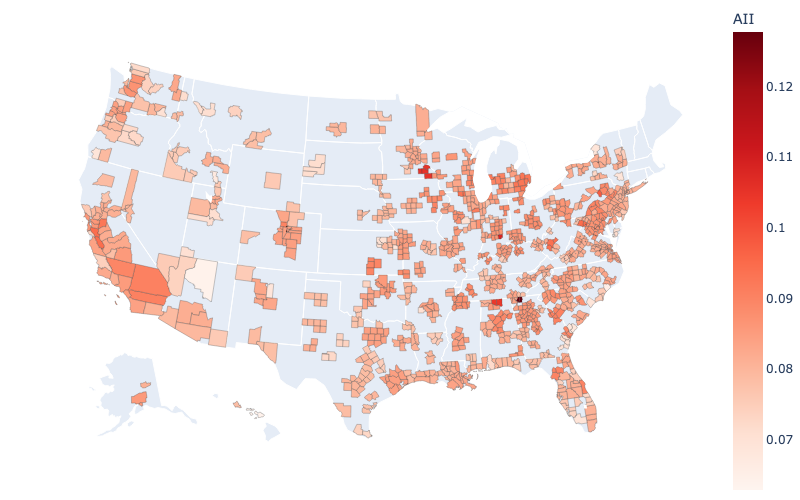
May be of interest… AI Is Reshaping American Cities - But Not Equally Daniele Quercia [cid:image001.png@01DBBFF9.91B8F060] Darker colours represent higher AI impact within MSAs. Grey areas indicate regions outside the boundaries of MSAs, which generally have lower population densities and are not included in the analysis due to limited data availability. Artificial intelligence promises to transform how we work, automating tasks, boosting productivity, and opening up new economic frontiers. But beneath the optimism lies a stark reality: AI's impact is far from evenly spread. In a new study<https://epjdatascience.springeropen.com/articles/10.1140/epjds/s13688-025-00...> published in Springer EPJ Data Science, we examined how AI is likely to affect labour markets across U.S. metropolitan areas. The results reveal a troubling pattern: one that risks deepening America’s existing economic divides. By analysing 24,758 AI-related patents filed between 2015 and 2022 and linking them to 17,879 occupational tasks, we developed a fine-grained map of where AI is likely to hit hardest. The findings defy the assumption that only major tech hubs are vulnerable. In fact, many of the most at-risk places are mid-sized cities whose economies hinge on a single sector. Dalton, Georgia, for example, is tightly bound to carpet manufacturing. Columbus, Indiana depends on the automotive industry. Rochester, Minnesota, renowned for its healthcare sector, also faces elevated risk. In each case, a heavy reliance on routine-intensive industries leaves these places exposed to automation, with few alternative sectors to soften the blow. In contrast, some of the least-impacted cities in our analysis such as Daphne-Fairhope-Foley in Alabama, Coeur d’Alene in Idaho, and Grants Pass in Oregon share a different trait: economic diversity. These cities spread employment across a broader range of industries, making them better equipped to absorb shocks and adjust as AI transforms specific sectors. We also found that the East Coast, on average, is more exposed to AI disruption than the West. Though highly innovative hubs like the Bay Area and Seattle remain high-impact outliers. Cities experiencing rapid growth in “creative class” jobs such as engineers, scientists, designers are also more likely to face disruption. Knowledge work, it turns out, is not immune to automation; in some cases, it is on the front lines. AI is not just a story of technological progress. It is a story of geography, resilience, and inequality. Left unchecked, it could entrench existing divides, fuelling growth in already-advantaged regions while sidelining those with fewer resources to adapt. The policy response must match the scale of the challenge: support for economic diversification, investment in re-skilling, and a renewed focus on regions at risk of being left behind. To help individuals and policymakers better understand what AI might mean for them, we’ve also made our data public. On our interactive platform<http://social-dynamics.net/aii>, users can explore how AI is projected to affect different occupations, and even drill down to specific tasks within those jobs to see which are most susceptible to automation. The AI revolution is underway. With the right tools and the right foresight, we can ensure it lifts more communities than it leaves behind.
participants (1)
-
 Daniele Quercia