PwC: Artificial intelligence will create as many jobs as it destroys - Business Insider

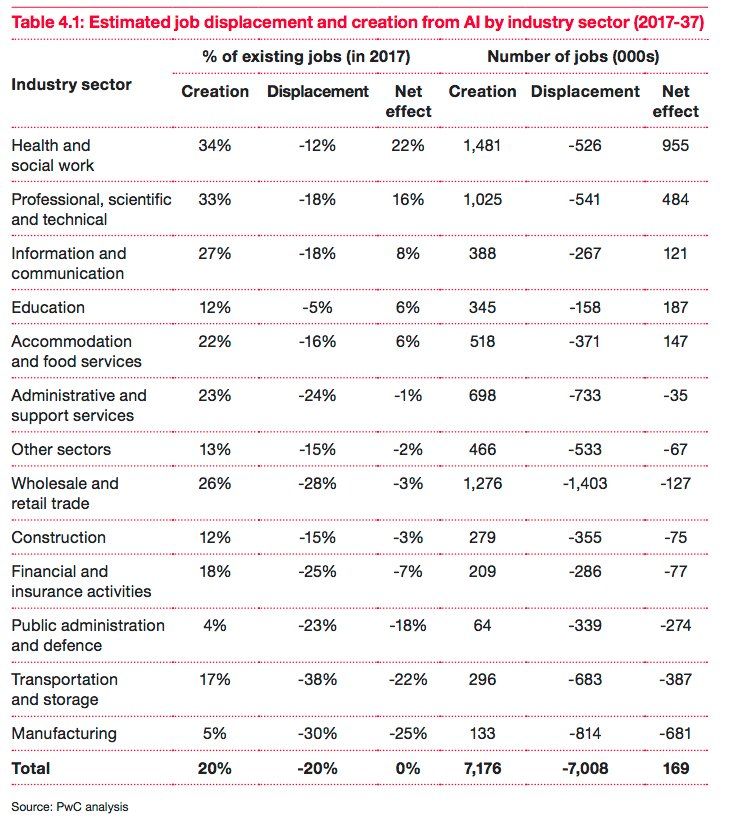
vexata questio Ma siamo sul filo di lana: p.es. in UK nel 2037: "In absolute terms, around 7 million existing jobs are projected to be displaced, but around 7.2 million are projected to be created, giving a net jobs boost of around 0.2 million." http://uk.businessinsider.com/pwc-artificial-intelligence-wont-destroy-all-j... Artificial intelligence will create as many jobs as it destroys, according to a PwC analysis • Shona Ghosh • • Jul. 17, 2018, 8:06 AM • Billionaires including Bill Gates and Elon Musk have argued that robots will basically replace humans at work. • People are now worried about vast swathes of unemployment where a few wealthy people own the robots and the rest survive on government handouts. • But a new PwC forecast suggests artificial intelligence will create as many jobs as it destroys. • AI will disproportionately affect certain sectors negatively such as manufacturing and transport, but will create jobs in healthcare and education. ________________________________________ The likes of Elon Musk and Bill Gates have made repeated doomsday warnings about artificial intelligence becoming more skilled at humans at just about everything. So it's little surprise that people are scared about a post-AI future where a mostly jobless population subsists on universal basic income while rich people own and operate all the robots. But a new report from consultancy firm PwC joins a growing chorus of more cautious economic forecasts that suggest the future is brighter than we might think. Looking at the UK, PwC found that it's true that robots will replace some jobs, especially in sectors like transport or manufacturing. AI will "displace" 38% of transport jobs, and 30% of manufacturing jobs, according to the report. But other sectors will actually see greater job creation thanks to AI, evening out the balance. Only 12% of jobs in healthcare will be displaced by AI, while 34% will be created, PwC predicts. The upshot is that AI will create as many jobs as it destroys, when evened out across different sectors. The report said: "Our estimates suggest that AI will not lead to technological unemployment as we project that it will displace around 20% of existing UK jobs by 2037, but create a similar number. "In absolute terms, around 7 million existing jobs are projected to be displaced, but around 7.2 million are projected to be created, giving a net jobs boost of around 0.2 million." The OECD was even more conservative about job displacement in a report earlier this year. The economic organisation concluded that just 14% of jobs in its member countries were at risk of automation. Both PwC and the OECD suggested that sectors that would benefit the most from AI, or are at least risk from automation, are those that involve complex, specialised tasks and people. This includes: • Education • Scientific and technical work • Information and communication • Accommodation and food services Sectors that will do badly include those that involve repetitive, administrative tasks such as: • Finance and insurance • Retail • Construction • Public administration • Construction • Transport • Manufacturing Here are the full UK numbers from PwC showing AI job creation and displacement in different sectors: PwC [cid:344390ae-969b-4b6b-b34d-3333ef5461dd]

Forecast a 20 anni. Senza accuratezza dichiarata. A chi li prende sul serio, offro divinazioni a lungo termine a prezzi modici. :-) Giacomo 2018-07-19 12:51 GMT+02:00 gabriele elia <gabriele.elia@live.com>:
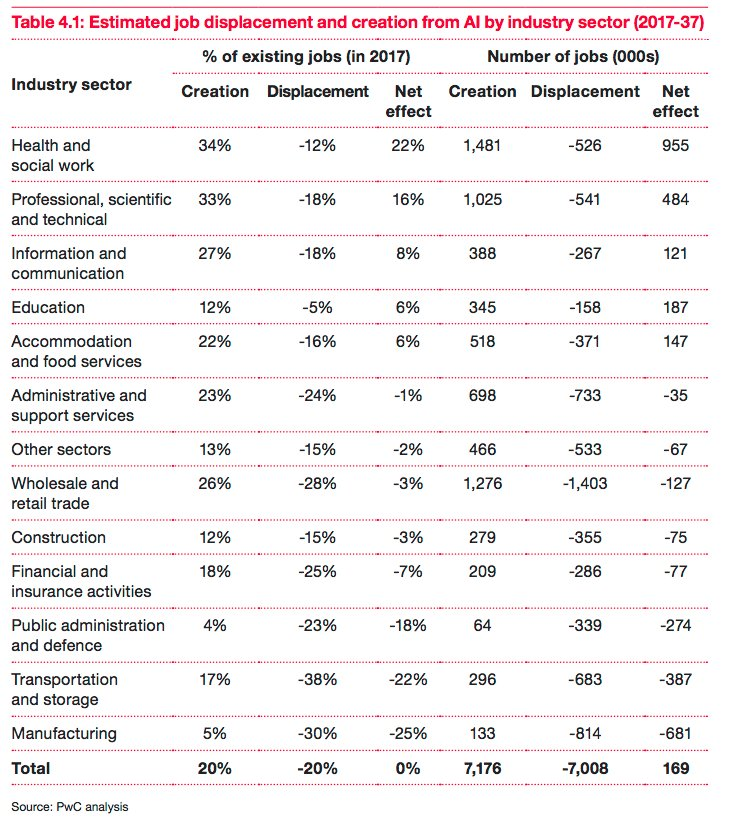
vexata questio Ma siamo sul filo di lana: p.es. in UK nel 2037: "In absolute terms, around 7 million existing jobs are projected to be displaced, but around 7.2 million are projected to be created, giving a net jobs boost of around 0.2 million." http://uk.businessinsider.com/pwc-artificial-intelligence- wont-destroy-all-jobs-2018-7?IR=T Artificial intelligence will create as many jobs as it destroys, according to a PwC analysis • Shona Ghosh • • Jul. 17, 2018, 8:06 AM • Billionaires including Bill Gates and Elon Musk have argued that robots will basically replace humans at work. • People are now worried about vast swathes of unemployment where a few wealthy people own the robots and the rest survive on government handouts. • But a new PwC forecast suggests artificial intelligence will create as many jobs as it destroys. • AI will disproportionately affect certain sectors negatively such as manufacturing and transport, but will create jobs in healthcare and education. ________________________________________ The likes of Elon Musk and Bill Gates have made repeated doomsday warnings about artificial intelligence becoming more skilled at humans at just about everything. So it's little surprise that people are scared about a post-AI future where a mostly jobless population subsists on universal basic income while rich people own and operate all the robots. But a new report from consultancy firm PwC joins a growing chorus of more cautious economic forecasts that suggest the future is brighter than we might think. Looking at the UK, PwC found that it's true that robots will replace some jobs, especially in sectors like transport or manufacturing. AI will "displace" 38% of transport jobs, and 30% of manufacturing jobs, according to the report. But other sectors will actually see greater job creation thanks to AI, evening out the balance. Only 12% of jobs in healthcare will be displaced by AI, while 34% will be created, PwC predicts. The upshot is that AI will create as many jobs as it destroys, when evened out across different sectors. The report said: "Our estimates suggest that AI will not lead to technological unemployment as we project that it will displace around 20% of existing UK jobs by 2037, but create a similar number. "In absolute terms, around 7 million existing jobs are projected to be displaced, but around 7.2 million are projected to be created, giving a net jobs boost of around 0.2 million." The OECD was even more conservative about job displacement in a report earlier this year. The economic organisation concluded that just 14% of jobs in its member countries were at risk of automation. Both PwC and the OECD suggested that sectors that would benefit the most from AI, or are at least risk from automation, are those that involve complex, specialised tasks and people. This includes: • Education • Scientific and technical work • Information and communication • Accommodation and food services Sectors that will do badly include those that involve repetitive, administrative tasks such as: • Finance and insurance • Retail • Construction • Public administration • Construction • Transport • Manufacturing Here are the full UK numbers from PwC showing AI job creation and displacement in different sectors: PwC
_______________________________________________ nexa mailing list nexa@server-nexa.polito.it https://server-nexa.polito.it/cgi-bin/mailman/listinfo/nexa

On 2018-07-19 17:19, Giacomo Tesio wrote:
Forecast a 20 anni. Senza accuratezza dichiarata.
e quello è il problema minore. Seguiamoli, ammettiamo che l'accuratezza sia del 100%, e che andrà, numericamente, esattamente così:
Ma siamo sul filo di lana: p.es [1]. in UK nel 2037: "In absolute terms, around 7 million existing jobs are projected to be displaced, but around 7.2 million are projected to be created, giving a net jobs boost of around 0.2 million."
Rimanebbe il fatto che almeno il 90% delle persone che perderanno quei 7 milioni di posti di lavoro "vecchi" non sarà mai in grado, nemmeno se scendesse ad aiutarli il padreterno, di "riqualificarsi" a) abbastanza per quasi tutti quei nuovi 7.2 milioni di posti, e b) abbastanza in fretta per non ritrovarsi in mezzo a una strada. boh. Marco -- http://mfioretti.com
participants (3)
-
 gabriele elia
 -
 Giacomo Tesio
 -
 M. Fioretti